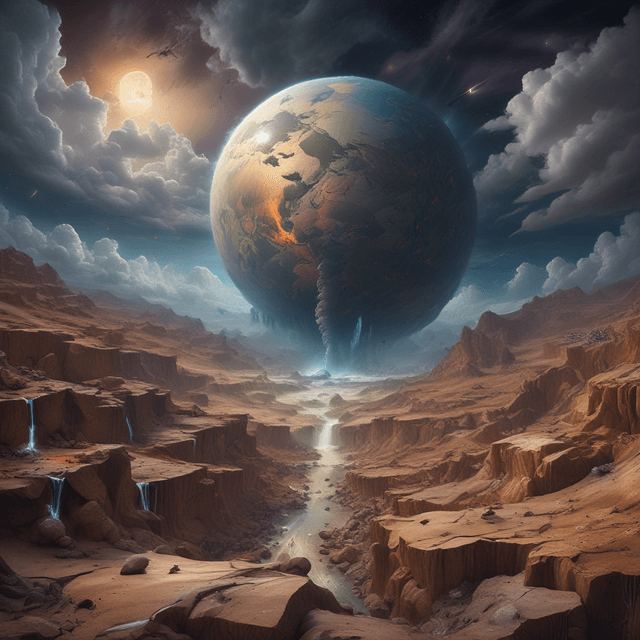
| Year | 2500 |
| Cause | Mysterious cosmic event |
| Event | The Fracture of Earth |
| Effects | Massive quake split Earth's crust and mantle • Planet fractured into multiple drifting fragments • Climate and environment thrown into chaos • Destructive storms, loss of habitable land • Breakdowns in food and energy production • Billions of humans perished • Survivors adapt to living on isolated chunks of former Earth • Efforts to establish new societies and infrastructure underway • Long-term outlook uncertain as humanity grapples with global calamity |
In the year 2500, a catastrophic event occurred that would forever change the face of planet Earth and the course of human civilization. On the night of June 15th, a massive quake of unknown cosmic origin shook the very foundations of the world, ripping the Earth's crust and mantle apart in a series of cataclysmic fractures.
Seismographs and astronomical observatories around the globe detected the first signs of the impending disaster just minutes before it struck. Intense gravitational disturbances emanating from deep space caused massive tectonic activity, building to a crescendo as the planet's interior was subjected to forces beyond anything ever witnessed.
Within the span of less than an hour, the Earth's surface was torn asunder, with gaping fissures opening up across every continent and ocean. Entire landmasses broke apart, with sections of the crust drifting away from each other at alarming speeds. The planet's molten mantle was violently exposed, spilling magma and superheated gases into the atmosphere.
The sheer scale of the devastation was unprecedented in human history. Earthquakes registering over 12.0 on the Richter scale rocked the globe, triggering tsunamis, volcanic eruptions, and other natural disasters on a apocalyptic scale. Billions of people perished in the initial fracturing and its immediate aftermath.
The fragmentation of the Earth had catastrophic consequences for the planet's climate and environment. The disruption of tectonic and atmospheric systems led to a breakdown of the delicate balance that had sustained life for billions of years.
Massive amounts of greenhouse gases were released into the atmosphere, causing runaway global warming that melted ice caps and glaciers. Sea levels rose dramatically, submerging many of the remaining coastal regions.
The disruption of ocean currents and magnetic fields caused weather patterns to become increasingly erratic, with superstorms, droughts, and temperature extremes becoming the new norm. Entire ecosystems were destroyed, leading to the mass extinction of plant and animal species that could not adapt to the new conditions.
With the physical world in chaos, human civilization quickly crumbled. Transportation, communication, and energy infrastructure was devastated, cutting off communities from one another. Supplies of food, water, and other essential resources became scarce, sparking widespread unrest, conflict, and the breakdown of social order.
Billions perished in the initial fracturing and the resulting environmental catastrophes. Governments and economies collapsed, and the few surviving population centers were quickly overwhelmed by desperate refugees fleeing the disasters.
In the years following the Fracture, the remaining pockets of humanity struggled to establish new societies on the isolated chunks of the former Earth. Some communities reverted to subsistence living, while others attempted to rebuild technological infrastructure from scratch. However, the long-term viability of these fragmented settlements remained uncertain.
To this day, the precise cause of the Cosmic Quake that fractured the Earth remains unknown. Scientists and astronomers have proposed numerous theories, from rogue black holes to cosmic string collisions, but definitive proof has remained elusive. The immense gravitational forces involved were unlike anything previously documented.
Ongoing research continues into the implications of the Fracture, both for the planet's future and the prospects for human survival. Questions remain about the long-term stability of the newly formed "shards" of Earth, the feasibility of reconnecting them, and whether the climate can ever be restored to a habitable state.
With billions dead and the future of civilization hanging by a thread, the Fracture of Earth stands as one of the greatest calamities in the history of our species. Whether humanity can adapt and ultimately recover from this unprecedented planetary disaster remains to be seen.
